
Augmented Reality AI Transforms Hand Hygiene Training
Augmented reality AI can boost confidence in hand hygiene without slowing education down.
A new pilot study shows that augmented reality (AR)–based hand hygiene training is feasible, engaging, and time-efficient for radiography students, with measurable gains in confidence that persist into clinical placement.
Blue Mirror, an AI-enabled augmented reality (AR) hand hygiene system, has demonstrated strong potential to improve confidence and engagement among radiography students, according to a new pilot study published in Radiography.
What the study found
Researchers at the University of Sydney evaluated an AR + AI hand hygiene system used by undergraduate radiography students before their first clinical placement. The system guided learners through WHO-aligned hand hygiene steps using a mirror-style interface and automated assessment.
Key findings:
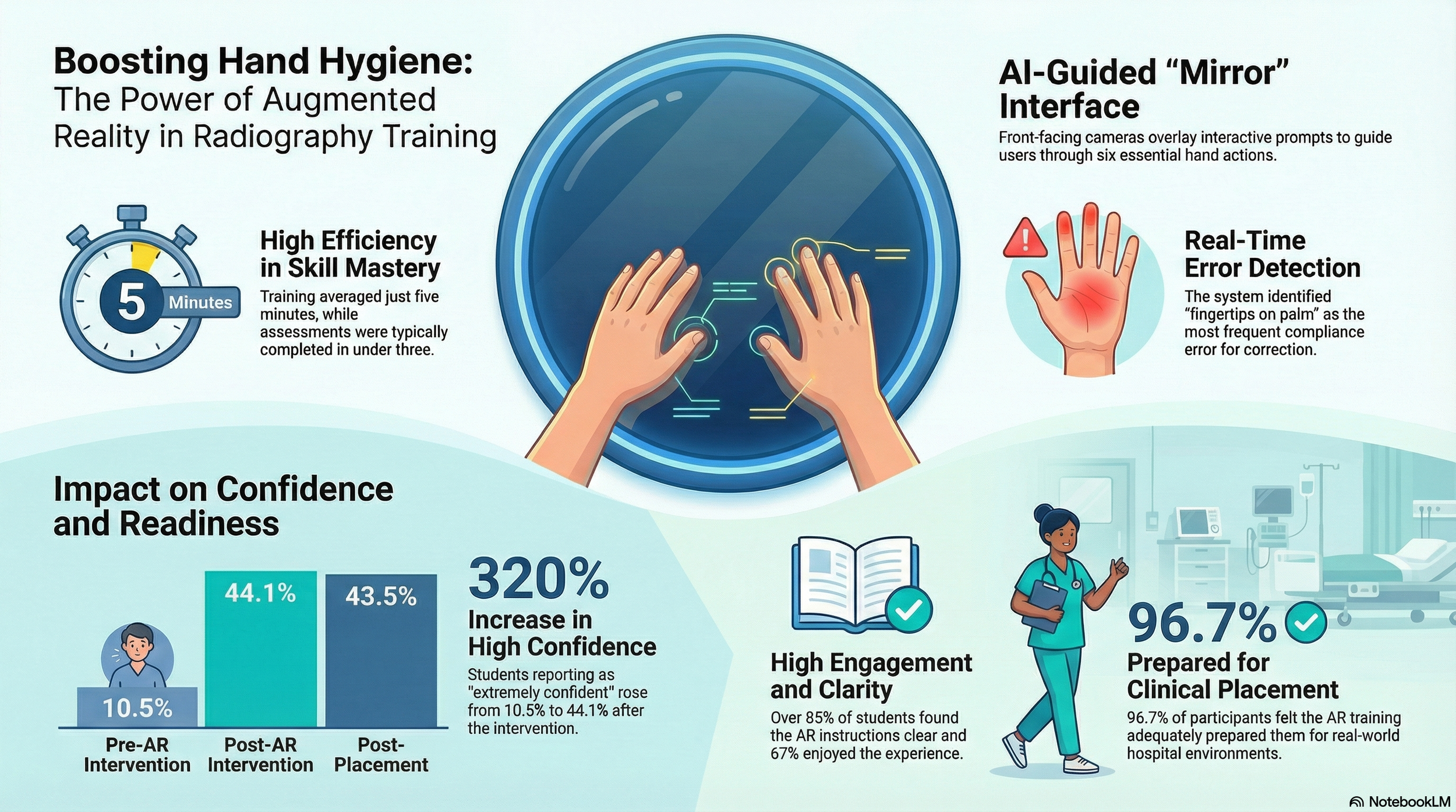
Confidence increased substantially: Students reporting being “extremely confident” rose from 10.5% pre-training to 44.1% post-training, remaining high after clinical placement.
Knowledge was already high and stayed high: Correct responses exceeded 87% at all time points, highlighting AI’s role in skills reinforcement rather than basic knowledge acquisition.
Training was fast: Average training time was ~5 minutes, and assessment took ~3 minutes, supporting scalability in busy curricula.
Engagement was strong: Most students described the AI + AR experience as interactive, enjoyable, and effective.
Actionable insights from errors: The system consistently detected missed steps.
The majority of students (93%) reported following AR-trained protocols during clinical placement, and nearly all felt adequately prepared for real-world practice.
Why it matters
Healthcare-associated infections remain a major, preventable burden, and hand hygiene compliance is still suboptimal despite decades of education. Traditional training is resource-intensive and inconsistent across clinical sites.
This study demonstrates that AI can deliver standardized, repeatable, and objective hand hygiene training with minimal educator burden—addressing known gaps in infection prevention education and aligning with global IPC priorities.
Student voices
Students highlighted the practical and engaging nature of Blue Mirror’s AR approach:
“Pretty cool way of doing hand hygiene practice.”
“I liked how easy and low-pressure the experience was.”
“It was interactive and gave instant response.”
“It was very clear and I now feel confident completing hand hygiene.”
Strengths—and limitations
Strengths: Real-time feedback, objective performance data, short training times, and high learner satisfaction.
Limitations: Single-institution pilot study and no long-term follow-up on sustained behavior change.
The authors emphasize the need for larger, longitudinal studies to assess durability of skills and impact on clinical compliance.
The bigger picture
Evidence increasingly shows that immersive technologies outperform passive education for infection prevention skills. AI offers a practical alternative to virtual reality, avoiding high costs and cybersickness while maintaining experiential learning benefits.
AI-enabled AR systems—such as those used in this study—represent a scalable path forward for IPC education across disciplines, not just radiography.
Practical next step
Healthcare organizations and educators should consider integrating AI-driven AR training into pre-clinical education and ongoing competency programs.
👉 Explore practical AI-based PPE and hand hygiene training at:
https://www.bluemirror.ai
Reference
Amadita K, Abu Awwad D, Gray F, et al. Exploring augmented reality for hand hygiene training in radiography students: A pilot study. Radiography. 2026;32:103335.
https://doi.org/10.1016/j.radi.2026.103335